|
Gary was working for Martin Bailey - not of airwaves
fame - (the Deputy director of the University of the
Witwatersrand Materials Handling Research Unit) while
completing his Masters Degree. Together they were
freelance consulting to industry on facilities
planning and materials handling projects.
It was not long before Bergman and Partners saw the
potential of these talented two young men and brought
them in-house as a specialist unit to generate lots of
work for their other divisions. "Working within this
environment was a paradoxical experience for us. On
the one hand the multi-disciplinary environment was
stimulating and exciting, but having effectively only
one client was very limiting," says Gary.
Ever-restless Gary however, left his pioneering mark
before their inevitable departure. "We saw the vision
and believed passionately that computers would
revolutionise engineering. Bergman was an old and
established consultancy born before BC - Before
Computers -, I was instrumental in moving Bergman and
Partners from dedicated workstations and into a PC and
networked environment. We also were some of the
original beta testers for a product called 'Cecile',"
says Benatar with a delighted smile. Cecile was, of
course, the forerunner of AllyCAD.
Industrial Logistics Systems was born when Gary and
Martin decided to leave Bergman. He and Martin set up
shop in their garage with Mrs Bailey acting as
secretary and offered their services to South African
industry as facilities planning and Materials Handling
experts. Fifteen years later, their client list blooms
brightly blue with top South African and international
companies.
Leaving Bergman and Partners on amicable terms, they
were doing basic layouts; then they started to handle
larger projects. Volkswagen and Toyota joined the
client list, and some projects were worth between R10
and R20-million - and that when the Rand was still
considered money! The small 2-man-and 1-woman-company
rapidly grew to 16 hardworking staff members.
"Clients then started to ask
questions around strategy, software and project
management. It made sense for us to supply, we had the
skills and the drive," says Gary. "Then in the early
nineties we were exposed to the world market and we
realised that we could compete, although we had some
work to do to get there." |
|
|
"We strove to bring ourselves into a 'best-practice'
logistics environment. We paid attention to every
aspect of the business, not just the warehouse design.
For example, we start at the beginning providing
supply chain strategy, e-commerce fulfillment and
integration, and where the warehouse should be
situated. Then comes the design of the facility, the
design of materials handling systems and the
development of everything to do with the warehouse."
"We get involved in the IT requirements, specifying
and selecting the systems, setting up the slotting
systems, the labour incentive systems and the system
audits. We also draw up the operational procedures,
the labour management systems, the training manuals,
and direct the 'go-live phase' when the pressure is
really on. Finally we integrate the total logistics,
doing fleet analysis, selection and management,
setting up track and trace systems, etc. Although I
have mentioned only a few of the skills we provide,
you can see that we get totally involved from the
strategy to the execution," says Gary.
With almost 5 years to go to the end of the century,
Cape Town loomed large on the planning horizon. The
move to Cape Town was implemented as a carbon copy of
the start-up plan years before. ILS Cape Town started
trading from Gary's house overlooking Table Bay.
"After 18 months we had to move into new offices in
Granger Bay that are now our head office. It was here
that in 1999 we looked hard at the business again and
restructured. We focused on what we do, what we offer
and how it should run."
"Our clients such as Shoprite, Clicks, DISTELL,
Vodacom, McCains, Dunlop, Priceline in Australia and
De Beers come to us at the beginning of a project, and
we walk the entire road with them. We integrate so
closely with our clients that we even make a point of
buying their products, which is a problem with Nestlé,
I have a sweet tooth" says Gary with a smile.
"All our industrial engineers start in operations, and
work their way 'back' to strategy and planning. When
they design, it works because they can visualize it -
they have been there. We analyse the data throughputs
and the methods, then develop an operations blueprint,
which leads to the facility infrastructure design.
This is an interactive process; we often have the
client in our boardroom and we design on the screen
with AllyCAD. We can simulate the space requirements,
and test the flows for balance and bottlenecks."
"We were responsible for the integration of 39 DC's in
19 after the merger of SFW and Distillers into DISTELL.
The pressure was on, we had to have all DC's live by
October and we were appointed in February. We would
fly to 3 DC's on a day using the DISTELL corporate
jet, be back in our boardroom with the client the next
day doing the layouts and designs, and be ready to
hand over signed-off designs for board approval within
a week and then pass it on to the rack supplier and
professional teams responsible for getting the
buildings ready. DISTELL didn't only take this time to
just add volume, but to reengineer their total supply
chain to operate at lower costs and to best practice
principles"
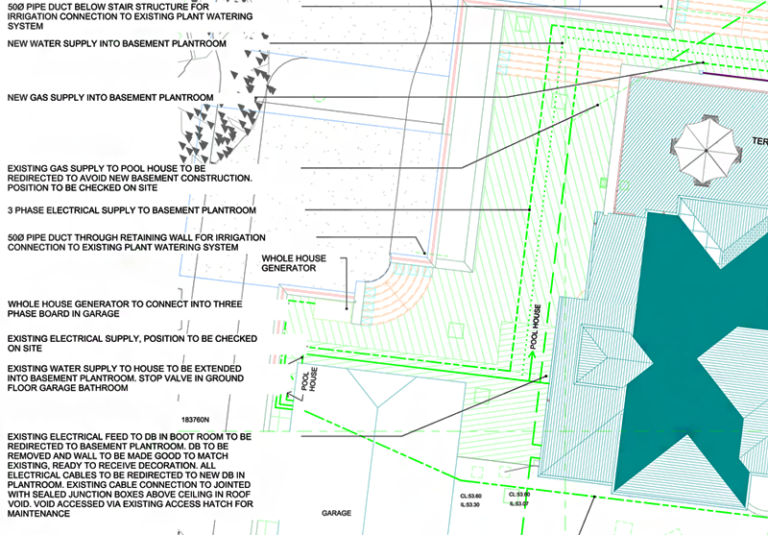
"AllyCAD is at the core of design, as we use it to
develop the operation blueprint. We even use it to
populate data fields in other software with 'xyz'
co-ordinates. On large projects the overlays become
critical in the design process. Having worked with
many different professional teams in the past means
that we can now bring that experience into any current
project.
"We have recently completed all the design work on
Shoprite's new DC in Gauteng. This will be the largest
DC of its type in the Southern Hemisphere. Ultimately
the site will have more than 150 000 m2 of
distribution infrastructure. Grocery distribution is
one of the most complex environments, the volumes are
enormous in excess of 5 000 000 cases a week. We have
to visualise the operations at this volume to
conceptualise the design, this would be impossible
without the flexibility of Allycad. We are currently
in the commissioning phase of the project to bring the
first 75 000m2 live by September - this project is one
of the most complex we have embarked on"
"We have invested heavily in IT technology that is
invaluable in our international projects. Recently
there was a problem with a supplier to one of our
international projects - just a simple translation
issue really, but we opened up the Video Conference
system, got the client involved and in just over an
hour the problem was no more. We videoconference with
our JHB office on an almost daily basis, this has
helped integrate the offices and make sure the culture
in the company is the same throughout. "
"We have been under pressure to change to AutoCAD, but
I cannot see the need. AllyCAD operates seamlessly
with all other software. Even our clients who are not
engineers don't have a problem with the 2-D
environment. I think it is really only architects that
need 3-D functionality. Another advantage of AllyCAD
is that you can design using simple geometry lines.
This means that you can play with it and adjust the
design to get it right first time. AutoCAD does not
allow you to test the process as you can only design
using co-ordinates. AllyCAD is also very fast," says
Gary. "I used AllyCAD to design the furniture in our
office. Gosh, I even used it to design furniture in my
house."
"From here we go international. We have some exciting
ideas and prospects in the pipeline. We have a good
name in the international arena; we don't have to
stand back for anyone. ILS is a positive place to be -
a fun place. Everyone has access to the facilities 24
hours a day. A number of my staff are still studying
and I give them every opportunity to qualify at their
top limits." The ever-present cellphone chirps
urgently on the desk. "It's a client," says Gary
unapologetically taking the call.
AllyCAD is an essential part of ILS. Just like their
dedication to best practice supply chain solutions,
AllyCAD is at the very heart of ILS - and close to
Gary Benatar's passionate heart. |